How to Appear in Google AI Overviews: A Guide for Indian Exporters and Heritage Brands
Google now generates an answer before showing any search result. Here is what that means for Indian exporters — and how to be the business it names.
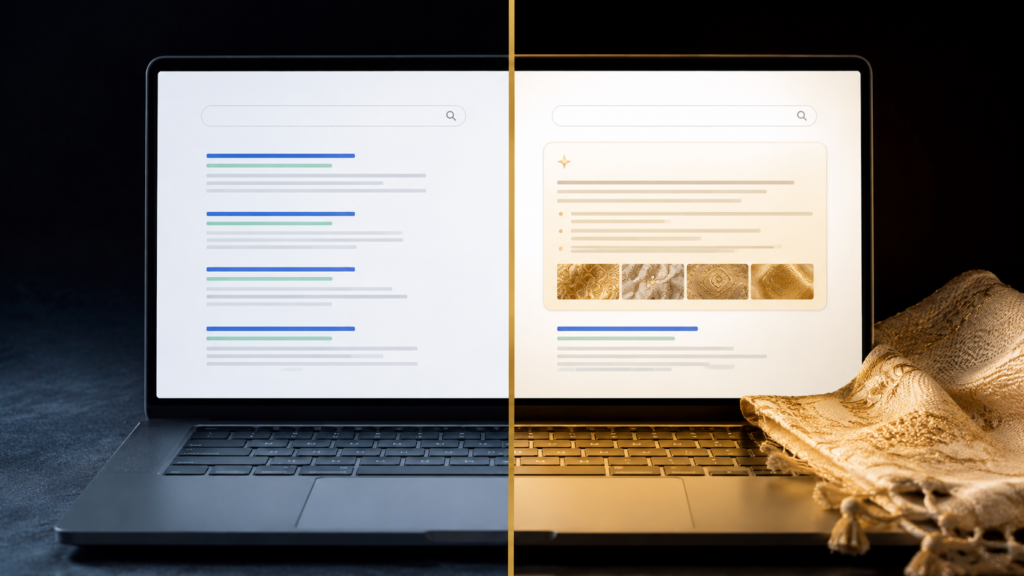
When a buyer in the United States searches for “Banarasi saree supplier for retail” or “Bhadohi carpet exporter India,” they no longer see a list of blue links first. They see a paragraph — generated by Google’s AI — that summarises the answer and names specific businesses, sources, and resources. Only then do the traditional search results appear below.
This is Google AI Overviews. For Indian exporters and heritage brands, it is one of the most consequential changes to search behaviour in the past decade. Appearing in Google AI Overviews for Indian exporters is no longer a bonus — it is the new first impression.
What Google AI Overviews Are
Google AI Overviews (launched globally in 2024, expanded through 2025) are AI-generated summaries that appear at the top of search results pages for certain queries. They pull from multiple sources across the web, synthesise the information, and present it as a direct answer — with citations to the sources used.
Unlike traditional featured snippets, which pull a single paragraph from a single page, AI Overviews assemble content from several sources simultaneously. They prioritise content that is clearly structured, authoritative, and written to answer a specific question rather than to rank for a keyword.
Google’s own documentation on AI Overviews describes the system as designed to help users “understand a topic faster” — which means it favours businesses and content that make understanding easy.
For the purposes of this guide, understanding AI Overviews is inseparable from understanding Generative Engine Optimization (GEO) — the broader practice of making your brand visible and citable inside AI-generated answers. Google AI Overviews are the most visible expression of this shift, but the same structural principles apply across ChatGPT, Gemini, and Perplexity.
Why Indian Exporters Need to Pay Attention Now
The buyers who matter most to Indian exporters — wholesale buyers in the UK, procurement managers in the UAE, retail importers in the US — are increasingly search-sophisticated. They do not browse directories. They search with specific intent: “best Indian handicraft supplier for boutique retail,” “handwoven silk export certification India,” “how to source Bhadohi carpets directly.”
Those searches now trigger AI Overviews. The businesses named in those overviews receive the click, the enquiry, and the credibility signal that comes with being cited by Google’s own AI.
The category of Indian exporters and heritage brands is, right now, underrepresented in those answers. Most Indian exporter websites were not built with structured content, schema markup, or the kind of entity clarity that AI systems require. That is a gap — and gaps in AI search are significantly easier to close early than after the category fills.
For a deeper look at how this differs from traditional search strategy, see GEO vs SEO: What Indian Brands Need to Understand.
What Determines Whether Your Business Appears in a Google AI Overview
Google has not published a precise algorithm for AI Overview inclusion. But analysis of which content is cited — by Search Engine Land, Semrush, and practitioners working in this space — consistently points to four factors.
Entity Clarity
Google needs to understand, unambiguously, who you are, what you do, where you are, and who you serve. This is called entity clarity. A business that describes itself as a “Varanasi-based Banarasi silk exporter serving retail buyers in the US and UK, with GI-certified products and 20 years of export experience” gives Google a clear entity signal. A business that says “we offer quality products at competitive prices” gives it nothing to work with.
Entity clarity must be consistent across your website, your Google Business Profile, your social profiles, and any external mentions. Inconsistencies — different names, different location descriptions, different service descriptions — dilute the signal.
Structured, Extractable Content
AI Overviews pull sentences and paragraphs that directly answer questions. Content written as flowing prose around broad themes is harder for AI to extract than content structured around specific questions with direct answers.
This means your service pages and blog posts should contain sentences that begin with the answer, not build toward it. “Bhadohi carpets are hand-knotted on pit looms by artisans trained through a hereditary apprenticeship system” is extractable. “At our company, we take great pride in the quality of our handcrafted carpets, which have been made using traditional methods passed down through generations” is not.
The guide on making your business visible in ChatGPT, Gemini and Perplexity covers the content structuring principles in more detail — the same rules apply to Google AI Overviews.

Schema Markup
Schema markup is machine-readable structured data embedded in your website’s code. It tells Google — and other AI systems — your business type, location, services, credentials, and relationships, in a format that does not require any inference or interpretation.
For Indian exporters, the most important schema types are LocalBusiness or ProfessionalService, Person (for founder-led brands), FAQPage, and Product (for exporters with a defined product catalogue). Most Indian exporter websites have none of these. That is a structural gap that directly reduces your likelihood of appearing in AI-generated answers.
E-E-A-T Signals
E-E-A-T stands for Experience, Expertise, Authoritativeness, and Trustworthiness — the framework Google uses to evaluate content quality. For exporters, E-E-A-T is demonstrated through: years of documented experience, named clients or partnerships, verifiable credentials (GI tags, export certifications, industry memberships), and citations on credible third-party websites.
A business with a 30-year track record that has documented that track record online has a significant E-E-A-T advantage over a newer competitor with a better-designed website but no verifiable history.
How to Optimise for Google AI Overviews — Five Steps
Step 1 — Establish Entity Clarity Across Every Surface
Write a clear, consistent entity statement for your business and use it everywhere: your homepage’s first paragraph, your Google Business Profile description, your LinkedIn About section, your export directories, your press mentions. The statement should include your product category, geography, target buyer market, and any verifiable credentials.
Example: “[Business Name] is a Bhadohi-based hand-knotted carpet exporter supplying retail buyers and interior designers in the US, UK and Germany. Established in 1987. GI-registered. Direct export, no intermediaries.”
Every word in that statement is a signal. Do not dilute it with marketing language.
Step 2 — Restructure Key Pages Around Buyer Questions
Identify the five to eight questions your most valuable buyers ask before placing an order. Write a section on your website that answers each one directly — one or two clear sentences per answer. Do not bury the answer in a paragraph. Lead with it.
These sections become your most citable content for AI Overviews. They are also the foundation of the FAQ sections that generate People Also Ask results in traditional search.
Step 3 — Add Schema Markup to Your Core Pages
Add LocalBusiness or ProfessionalService schema to your homepage. Add FAQPage schema to any page with a questions-and-answers section. Add Person schema if your brand is founder-led and your reputation is tied to your name. If you have a product catalogue, add Product schema with accurate descriptions, pricing ranges, and availability.
This does not require advanced technical knowledge. WordPress with Yoast SEO handles schema via the Schema tab on each page. For custom JSON-LD, a developer can implement it in under an hour per page.
Step 4 — Build Off-Site Citations
A business cited only on its own website has weak entity authority. AI systems look for external corroboration: mentions in industry directories, trade publications, news articles, partner websites, and institutional profiles. For Indian exporters, this means: India Mart listings (properly maintained, not abandoned), FIEO or EPCH directory presence, any press coverage of your export work, and profiles on international sourcing platforms.
Each credible external mention reinforces your entity signal and increases the probability that AI systems treat you as a known, trustworthy source.
Step 5 — Write FAQ Sections That Answer at Extract-Length
Every core page and blog post should have a FAQ section with four to eight questions. Keep answers between 40 and 80 words — long enough to be substantive, short enough to be extracted cleanly. Questions should mirror the exact phrasing buyers use, not the phrasing you prefer.
For Indian exporters and heritage brands specifically, this is one of the highest-leverage actions available. The category has almost no well-structured FAQ content online — which means the bar for inclusion in AI Overviews is currently low.
The Difference Between Ranking on Google and Appearing in AI Overviews
Traditional SEO optimises for ranking position in a list of ten results. AI Overview optimisation is different: it is about being the content that the AI chooses to extract and cite when assembling its answer. A business ranking at position six for a keyword may still appear in the AI Overview if its content is the most clearly structured and directly relevant. A business ranking at position one may not appear if its content is dense, hard to extract, or poorly structured.
This is the practical distinction between SEO and GEO. Both matter. They share a foundation — good content, credible links, a functioning technical stack. But GEO requires an additional layer: content that machines can read, extract, and cite.
For Indian exporters building international visibility, the AI SEO and GEO work is not a replacement for traditional SEO. It is the layer that makes everything else compound.
What to Do Next
The businesses that build AI Overview visibility now — in categories where competition is still sparse — will hold that position for years. AI systems, once they have established a reliable entity, are conservative about displacing it.
For Indian exporters and heritage brands, the window is open. The category is underrepresented. The structural work is achievable.
The starting point is an audit: what does your current site give AI systems to work with, and what is missing. If you would like that assessment, the conversation starts at the AI SEO and GEO service page.
Schedule a consultation | hi@rahulkagrawal.in | WhatsApp +91 97215 35277
rahulkagrawal.in · Varanasi, India
FAQs
A Google AI Overview is an AI-generated summary that appears at the top of Google search results for certain queries. It pulls from multiple web sources, synthesises the information, and presents a direct answer with citations — before any traditional organic results appear.
The core requirements are entity clarity (consistent, specific descriptions of who you are and what you do), structured content that AI can extract directly, schema markup on your key pages, and credible off-site citations that confirm your business exists and is authoritative in its category.
Yes. Studies by Semrush and Search Engine Land show that AI Overviews reduce click-through rates on organic results beneath them. However, businesses cited within the AI Overview itself receive significant traffic and trust signals. The priority is to be inside the answer, not below it.
Yes. A featured snippet pulls content from a single page and shows it verbatim. An AI Overview synthesises content from multiple sources and assembles a new answer. Being cited in an AI Overview typically requires structural signals across your entire website — not just one well-written paragraph.
There is no fixed timeline. Businesses with strong existing E-E-A-T, clear entity signals, and structured content often see results within weeks of implementing schema and content changes. Newer websites with thin authority may take three to six months of consistent content work before seeing consistent inclusion.
Both. International wholesale buyers, procurement managers, and retail importers use Google with B2B search intent — and those searches increasingly trigger AI Overviews. Appearing in those answers positions your business as the authoritative source at the moment a buyer is forming their shortlist.
It is one of the clearest signals available. Schema markup tells Google’s AI — unambiguously and in machine-readable format — what your business is, what it does, and where it operates. Without it, the AI must infer these things from prose, which introduces uncertainty and reduces citation probability.

Rahul Agrawal
https://www.rahulkagrawal.inRahul Agrawal helps heritage brands, textile exporters and handicraft businesses grow through AI visibility, GEO, Shopify and ecommerce strategy. Based in Varanasi, serving clients globally.