HomeEcommerce Website Designer in Varanasi

Ecommerce Website Designer in Varanasi

Building online stores that sell India's finest craft to the world — with architecture that converts, content that ranks, and a presence that compounds.

If you are looking for an e-commerce website designer in Varanasi, you are probably not just looking for someone to build pages. You are looking for someone who understands what it takes to sell handwoven silk, Bhadohi carpets, brass ware, or hand-knotted textiles to buyers in London, Dubai, New York and Melbourne — buyers who cannot touch the product before they buy, who form their opinion within seconds of landing on your store, and who will leave without a second thought if your website does not immediately communicate both quality and trust.

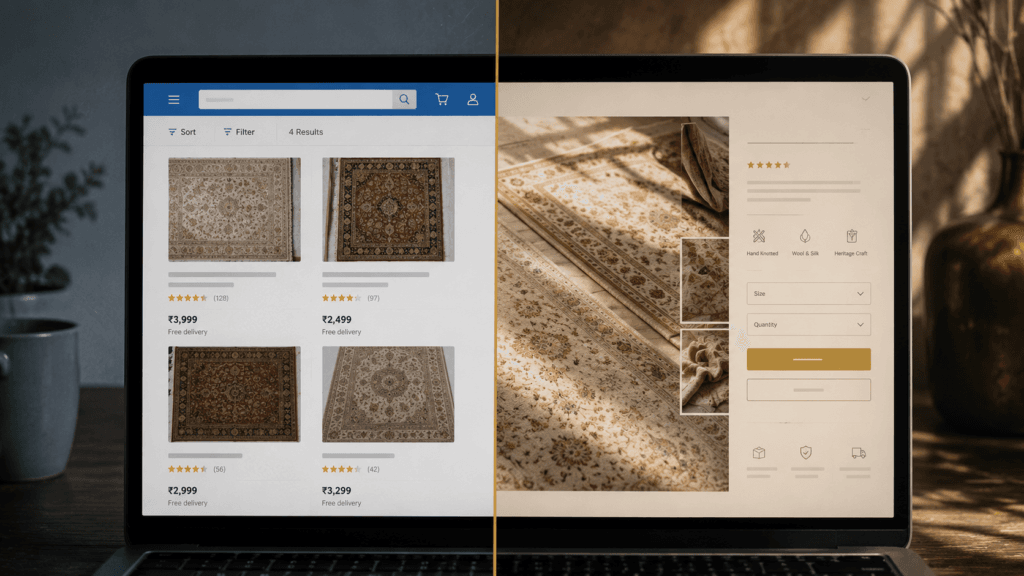
E-commerce website designer in Varanasi reviewing heritage craft store design — laptop beside Banarasi silk
The gap between a product worth thousands and a store that communicates that value is a design problem — one that can be solved.
Dimensions: 1600×900 (16:9)

That is a fundamentally different design problem from building a website for a restaurant or a software company. It requires someone who understands the craft, understands the buyer, and understands how the algorithms — and increasingly, the AI systems — that mediate between the two actually work.

This page is a detailed guide to that problem: what an e-commerce website for a Varanasi-based heritage or craft business needs to accomplish, what the design and build process looks like, how to evaluate the right partner, and what you should expect from the investment. It is also an account of my own practice — the approach I bring to every store I build, and the results it has produced for businesses in and around this city.

What Separates an E-commerce Website Designer from a Web Developer

The distinction matters, and most businesses discover it only after spending on the wrong one.

A web developer builds things. Given a specification, they will translate that specification into functioning code: pages load, buttons work, the cart checks out. A skilled developer is essential. But a developer’s job ends at execution — they are not responsible for whether the store actually sells anything.

An e-commerce website designer — in the fullest sense of the term — is responsible for the sales architecture. That includes the visual design, yes, but it also includes the information hierarchy: which products lead, how they are grouped, what information appears at what moment in the buyer’s journey, what objections the design preemptively answers, and what happens after someone adds a product to their cart. It includes the trust signals that tell an international buyer your business is legitimate, the photography and presentation standards that make your product feel premium at first glance, the navigation structure that helps a buyer who arrives searching for “Banarasi silk saree for wedding” find exactly the right product without friction.

It also includes what happens after launch — the search engine structure, the schema markup, the semantic layer that determines whether Google and AI answer engines can understand and surface your store when the right buyer is looking.

This distinction is why businesses that have already spent on “website development” often find themselves starting over. The developer delivered what was specified. What was not specified — the sales architecture — was never built.


If you’re looking for an e-commerce website designer in Varanasi who combines technical expertise with practical ecommerce experience, I’d be happy to discuss your project.

Here’s how we can start:

No pressure. Just an honest conversation about what’s best for your business.


The E-commerce Opportunity for Varanasi Businesses Right Now

Varanasi is one of India’s oldest and most storied trade cities. The textiles sector alone — Banarasi silk sarees, brocades, and woven fabrics produced in the looms of Jaitpura, Madanpura, and Bhelupur — has been shipping across subcontinents for centuries. The craft traditions of this region represent some of the most technically demanding and culturally significant production in the world.

What has changed dramatically in the past decade — and what continues to accelerate — is how buyers find and purchase these products. The international buyer who once found a Varanasi weaver through a trade fair in Frankfurt or an export agent in Mumbai can now find you directly. If your digital presence is structured correctly, they will. If it is not, they will find a competitor who has figured this out before you.

India’s e-commerce exports were valued at approximately $5 billion in 2024 and are projected to reach $200 billion by 2030, according to the Indian government’s Digital Commerce Export Policy framework. That trajectory reflects something most traditional businesses have not yet fully internalised: the global buyer has moved online, and the channel through which you reach them has fundamentally shifted. The middlemen — trading houses, export agents, marketplace commissions — are increasingly optional for businesses with a direct, credible digital presence.

That shift creates a genuine strategic opportunity. The businesses that build proper e-commerce infrastructure now — a store that is architecturally sound, well-positioned, and discoverable — will compound that advantage for years. The businesses that wait will find themselves building into a much more competitive landscape.

The challenge specific to Varanasi and the broader Purvanchal region is that the craft expertise is deep and the digital infrastructure expertise is thin. Most businesses are either absent online, dependent on platforms like Amazon or Flipkart (paying 15–25% commission on every order while building someone else’s marketplace), or running a website that was built for the purpose of “having a website” rather than for the purpose of selling.

The gap between those two states — a website that exists versus a website that sells — is exactly where the right e-commerce website designer in Varanasi can create significant value.

What Your E-commerce Website Must Do Before It Does Anything Else

Before discussing aesthetics, platforms, or features, it is worth being precise about what an e-commerce website is actually supposed to accomplish. This clarity prevents the most common and expensive mistake: optimising for the wrong thing.

An e-commerce website has one primary job: converting a visitor into a buyer. Everything else is in service of that — or it is not worth the time or money. This sounds obvious. In practice, most e-commerce websites fail at this basic task because they are designed around what the business wants to communicate rather than what the buyer needs to understand before they are willing to pay.

Baymard Institute’s research, the most rigorous ongoing study of e-commerce usability, consistently finds that 70–80% of carts are abandoned before checkout — and that a significant portion of those abandonments are caused by structural usability failures that have nothing to do with price or intent. The buyer wanted to purchase. The website made it difficult enough that they stopped. This is not a traffic problem. It is an architecture problem.

For Varanasi businesses selling heritage craft, the conversion challenge is compounded by several factors that generic e-commerce design frameworks do not address:

The product requires education before it earns its price. A Banarasi katan silk saree at ₹35,000 is not expensive for what it is — but a buyer who lands on a product page with a single image, a brief description and a buy button has no basis for understanding what makes it worth that price. The design must do the work of demonstrating value: the weave count, the hours of labour, the source of the silk, the provenance of the design. That is not just copywriting — it is a content architecture decision about what information lives where and how it is sequenced.

The buyer is often geographically distant and culturally unfamiliar with the product category. An NRI buyer in New Jersey or a first-generation British-Indian buyer in Leicester may be emotionally drawn to Banarasi silk but have limited ability to judge quality from a photograph alone. The design must bridge that gap through trust signals, certification, provenance storytelling and social proof that speaks to that specific buyer’s anxieties and desires.

Trust signals for international buyers differ from those for domestic buyers. International shipping policies, customs handling, return procedures, currency conversion, payment security — these are questions an international buyer is asking before they place an order. A store that does not answer them pre-emptively will lose those buyers, even if the product is exactly what they were searching for.

Mobile performance is not optional — it is the primary context. The majority of product discovery for artisan and heritage craft happens on mobile devices, increasingly via social channels. A store that is not designed and optimised for mobile from the first screen is not a serious e-commerce store, regardless of how it looks on a desktop browser.

An experienced e-commerce website designer in Varanasi should be able to address all of these dimensions — not as separate considerations but as a coherent architecture that answers the buyer’s questions in the right sequence and removes friction at every point in the journey.

Platform Choice: Shopify, WooCommerce, or Something Else

One of the first questions any business asks when planning an e-commerce build is: which platform? This is a meaningful question because the platform choice affects everything downstream — the cost structure, the maintenance burden, the design flexibility, the integration options, and the scalability ceiling.

For most Varanasi businesses building an e-commerce store for the first time, or rebuilding an underperforming one, the answer is usually Shopify. Here is the reasoning.

Shopify is purpose-built for e-commerce. It handles hosting, security, payment processing, checkout optimisation, and platform maintenance out of the box. This means the business owner does not need to manage a server, worry about security patches, or maintain a plugin stack. For businesses where the founder’s attention is better directed at product and operations than at technology maintenance, this matters significantly. Shopify’s checkout has been extensively tested and optimised — conversion rates on a properly configured Shopify store consistently outperform custom-built checkouts for businesses at the same traffic volume. Its ecosystem of apps, integrations, and Shopify Payments infrastructure is mature, and the platform is used by some of the world’s most successful e-commerce brands.

The objection to Shopify is usually cost: there is a monthly subscription fee, and Shopify charges transaction fees unless you use Shopify Payments (which requires a supported bank account — available in India through certain integrations). These are real considerations, but for any business doing more than ₹5–6 lakh per month in revenue, the operational simplicity and conversion performance of Shopify will typically return more than its subscription cost.

WooCommerce, the WordPress plugin, is the other serious contender. It is free to install, runs on your own hosting, and offers extensive customisation. For businesses that already have a WordPress website and want to add e-commerce functionality, or for businesses with specific integration needs not served by Shopify’s ecosystem, WooCommerce is a capable platform. The trade-off is maintenance: WooCommerce stores require regular attention — hosting management, plugin updates, security hardening, performance optimisation. This is not a problem if you have a development team, but for a founder-run heritage business, it often becomes a liability over time.

Custom platforms — built from scratch — are rarely the right answer for any business at the beginning of its e-commerce journey. The upfront cost is significantly higher, the maintenance burden falls entirely on the business, and the e-commerce functionality that Shopify and WooCommerce have refined over years must be rebuilt from the ground up. Custom builds make sense for businesses with truly unique product or process requirements that off-the-shelf platforms cannot accommodate. For most Varanasi textile and craft businesses, those requirements do not exist.

My recommendation for most clients is Shopify, with a properly designed theme, a rationalised app stack, and a clear merchandising and content strategy. That combination produces a store that is maintainable, fast, and built to convert. If you would like a deeper examination of the Shopify-specific considerations for Indian heritage businesses, the Shopify Consulting page covers that territory in detail.

Design That Sells Heritage Craft Online

Generic e-commerce design principles — clean layouts, fast load times, clear calls to action — apply everywhere. But designing an e-commerce website for Banarasi silk sarees, hand-knotted carpets, brass sculptures or handloom textiles involves a layer of considerations that most e-commerce designers do not encounter.

Product photography is the most important design element and the most frequently under-invested. This is not a graphic design statement — it is a sales architecture statement. For a product that a buyer cannot physically examine, the photography is the product. A handwoven Banarasi saree with a 5,400 thread-count brocade border deserves photography that shows that border in detail: the texture, the sheen, the precision of the weave. A flatlay with ambient light from a ring light on a white background does not communicate that. Editorial product photography — styled, carefully lit, showing the product in context and in detail — is one of the highest-return investments a heritage craft business can make. The design of your store should be built around photography that does its job.

Provenance and craft narrative must be designed into the product page, not relegated to an About page nobody reads. The buyer who is considering a ₹40,000 saree wants to know where it was woven, how long it took, what the significance of the design motif is, and why this weaver’s work is worth that price. That information does not fit comfortably in a standard product description field. It requires a structured product page design that accommodates extended content — a “story” section below the fold, a craft detail gallery, a weaver profile, a design provenance note. This is a design decision as much as a content decision.

Trust signals must be visible before the buyer needs to look for them. Free returns, secure checkout, India Post registered shipping with tracking, international delivery timelines, authenticity certification, GI tag recognition — these are not page elements to hide in the footer. They belong in the header, on the product page, in the cart. An e-commerce website designer working on heritage craft stores should approach these as fundamental design components, not afterthoughts.

Size, drape and colour accuracy are specific conversion problems for textiles. A buyer who cannot be sure of the exact colour of a silk saree — because monitor calibration varies and photographed colours rarely match true colours precisely — is a buyer with a pre-existing reservation about purchasing. Addressing this: a colour accuracy note on the product page, a whatsapp-enabled fabric swatch service, a clearly generous return policy on colour-related issues. Again, these are design decisions — where do these elements live on the page, how prominently are they surfaced?

International buyer infrastructure is not an afterthought. If you are building a store to sell to buyers in the UK, US, Gulf or Southeast Asia, the design must reflect that from the first screen: currency switching, international shipping options, a checkout that accepts international cards and PayPal, a clearly stated import duty policy (or DDP shipping that absorbs it). An e-commerce website that was built for domestic Indian buyers and then given an international shipping option added later is not the same thing as a store that was designed for international buyers from the beginning.

The Build Process: What Working with an E-commerce Website Designer Actually Looks Like

Understanding what the process looks like helps set realistic expectations and lets you ask better questions before committing to a designer. Here is how I approach a new e-commerce build.

Discovery and strategy (weeks 1–2). Before any design work begins, I need to understand the business, the product range, the target buyer, the competitive landscape, and what the current digital presence looks like (if one exists). This phase includes: a detailed intake conversation, a review of existing assets (photography, branding, product catalogue), a competitive audit of comparable e-commerce stores in the category, and a clear agreement on goals — what does success look like at six months, at twelve?

This phase is where the platform choice is confirmed, where the information architecture is sketched, and where the content requirements are scoped. It is also where the investment in photography — if it is inadequate — is identified and addressed. I will not build a store around photography that will undermine the finished product.

Information architecture and wireframing (weeks 2–3). Before visual design begins, the structure of the store is mapped: the navigation taxonomy, the collection hierarchy, the product page template, the home page content blocks, the checkout flow. This is delivered as a wireframe — a structural map of the store without visual styling. Reviewing and approving the wireframe before design begins saves significant time and cost downstream, because structural changes are cheap at the wireframe stage and expensive after design is applied.

Visual design (weeks 3–5). With the structure approved, visual design applies your brand’s aesthetic — colour palette, typography, photography treatment, spacing, and the micro-design details that communicate premium quality at a subconscious level. For Varanasi heritage businesses, the design palette typically draws from the product itself: the warmth of raw silk, the depth of indigo and crimson, the precision of gold zari. The store should feel continuous with the product — not like a generic template with a logo dropped in.

Build and configuration (weeks 5–8). The design is implemented on the chosen platform, apps are configured (reviews, search, wishlists, returns management, currency switching, analytics), the product catalogue is uploaded with structured content, and the checkout is tested across devices and payment methods. Performance is benchmarked and optimised: Core Web Vitals scores, mobile load time, checkout completion rate on test transactions.

Content and SEO configuration (weeks 7–9). The SEO layer — page titles, meta descriptions, URL structure, schema markup, image alt text, sitemap — is configured before launch, not after. This is a common error: treating SEO as something to “add later” means launching a store that search engines cannot properly read, and losing weeks or months of indexing time. The Ecommerce Growth Strategy work often begins here, with the initial keyword map and content plan for the store.

Launch and post-launch period (week 9 onwards). Launch is not the end of the process — it is the beginning of the learning phase. In the first four to six weeks after launch, conversion data, heatmaps, and search performance data reveal where buyers are dropping off, which products are performing, and what structural refinements will improve performance. A good e-commerce website designer should be present in this phase, not absent.

Beyond Launch: SEO, AI Visibility and Ongoing Discoverability

A store that launches without an ongoing discoverability strategy is a store that depends entirely on paid traffic or social media promotion to drive revenue. That is a viable short-term approach and an expensive long-term one.

Search engine optimisation for e-commerce stores is a specific discipline. It is not the same as SEO for a blog or an information website. The primary goal is to make product and collection pages discoverable for the specific search terms a buyer uses when they are ready to purchase: “Banarasi silk saree for wedding online,” “hand-knotted carpet Bhadohi export,” “pure silk dupatta with gold zari border.” These are transactional searches — the buyer is looking to buy, not to learn. Capturing them through organic search is some of the highest-return traffic available to an e-commerce business.

Achieving it requires: keyword-structured collection pages that target specific buyer searches, product page content that is rich enough to earn search visibility, a technical SEO foundation that allows Google to crawl and index the store efficiently, and a consistent content programme that builds the store’s topical authority over time. This is not a one-time setup — it is an ongoing investment that compounds.

Equally important, and increasingly urgent, is AI search visibility. Buyers are beginning to ask ChatGPT, Gemini and Perplexity for product recommendations: “where can I buy an authentic Banarasi saree online,” “best place to buy Bhadohi carpets in India.” The AI systems that answer those questions draw on a different set of signals than Google’s ranking algorithm. They prioritise entity clarity, citation-worthy content, and a brand footprint that is coherent and authoritative across the web. Building this layer — what is called Generative Engine Optimization (GEO) — is now a meaningful differentiator for e-commerce businesses that want to be visible to the next generation of buyers, not just the current one.

The relationship between e-commerce design and discoverability is not optional. A store that is beautifully designed but invisible in search and AI systems is a store that requires a continuous paid advertising budget to generate revenue. A store that is both well-designed and well-optimised compounds its advantage over time.

The Seven Questions to Ask Before Hiring an E-commerce Website Designer

If you are evaluating multiple designers or agencies for an e-commerce project, these seven questions will tell you more than a portfolio review or a proposal document.

1. Can you show me the conversion rate of stores you have built — not just the design? A portfolio of beautiful stores is evidence of design skill. Conversion rate data — average order values, checkout completion rates, organic traffic growth after launch — is evidence of sales architecture skill. Any serious e-commerce designer should have some of this data and be willing to share it.

2. What is your process for information architecture before visual design begins? If the answer is “we jump straight into design,” that is a warning sign. The structure of a store — its navigation, collection hierarchy, product page template — should be deliberated and approved before any visual work is done. Designers who skip this step produce stores that look good but are structurally confused.

3. Who handles SEO configuration, and when does it happen? If the answer is “that’s a separate engagement after launch,” probe further. The SEO foundation — URL structure, schema markup, meta titles, image optimisation — must be baked in before launch. Adding it afterwards means the store launches with a structural penalty.

4. What platform do you recommend for my specific business, and why? A designer who recommends the same platform to every client regardless of the business model, revenue stage, and operational capacity is not giving you strategic advice — they are giving you the answer they are most comfortable executing. The right platform recommendation should be specific to your situation.

5. What does the post-launch engagement look like? Launch is not the finish line. Ask specifically what support is included in the project scope for the first 30, 60, and 90 days after launch, and what data the designer will review with you to inform early optimisation decisions.

6. How do you handle product photography requirements? If your current photography is not adequate for e-commerce — and for most craft and heritage businesses it is not — ask how the designer addresses this. Offering to “design around what you have” is not a satisfactory answer. Inadequate photography undermines a well-designed store. A serious e-commerce website designer will tell you this clearly and help you solve it.

7. What is your experience with the type of product we sell? Generic e-commerce experience and experience with heritage craft, textiles, and artisan products are different things. The buyer psychology, the content requirements, the trust signals, the international buyer considerations — all of these are specific to the category. Experience with similar product categories is a genuine differentiator.

Common Structural Mistakes — and How to Avoid Them

Having reviewed dozens of e-commerce stores built by businesses in and around Varanasi, certain patterns of failure appear with enough frequency to be worth naming.

Building a catalogue rather than a store. Many e-commerce websites for craft businesses are, in practice, digital product catalogues: a list of products with photographs and prices, but without the persuasive architecture that moves a browser toward a buyer. A catalogue shows what you have. A store is designed to sell it. The difference lies in how products are positioned, how trust is built, how the buyer’s questions are answered before they need to ask, and how the journey from product discovery to checkout is structured.

Treating the home page as a billboard. The home page of an e-commerce store is not advertising space. It is the first moment in a buying journey, and its primary job is to orient the visitor — quickly, clearly — to what the store sells, who it sells to, and why they should trust it. A home page that leads with a full-screen autoplay video and a vague tagline is a home page that fails to do that job.

Under-investing in product page content. Product pages are where purchase decisions are made. A product page with two photographs, a three-sentence description and a price is not equipped to make a sale for a ₹25,000 silk saree or a $400 hand-knotted carpet. The product page for a premium heritage product should include: multiple high-quality photographs showing different aspects and details, a structured description that covers material, technique, origin and care, a provenance or craft narrative section, size and weight information, shipping timelines, a returns policy statement, and social proof (reviews, endorsements). This is a content architecture investment, and it is where most stores fall short.

Launching without a discoverability strategy. A store without an SEO and content plan is entirely dependent on paid advertising or social media to drive traffic. Those channels work, but they stop working when you stop paying. Organic traffic — from search engines and, increasingly, from AI answer systems — compounds over time and is the basis of a sustainable e-commerce business. Launching without this foundation means starting over on discoverability after the store is live.

Over-reliance on marketplace channels. This point applies beyond website design but is worth naming here. The businesses that use their own e-commerce store as a primary sales channel, with marketplaces as a supplementary one, are building equity. The businesses that treat a marketplace as their primary channel are building dependency — paying 15–25% commission on every order, subject to policy changes they cannot control, without building customer relationships they own. A well-designed direct-to-consumer store is not a replacement for marketplace presence — it is the asset that makes marketplace presence optional rather than essential.

Investment: How to Think About E-commerce Website Design Cost

The question most founders ask first — and it is a reasonable question — is: what does this cost?

The honest answer is that the cost of e-commerce website design in India varies significantly based on what is actually being built. A template-based WooCommerce store built by a freelancer in two weeks is a very different engagement from a custom-designed Shopify store with a full information architecture process, optimised product page templates, SEO configuration, and post-launch support.

At Infomark Global, my agency which has been operating for over 18 years, we have built e-commerce stores at a range of investment levels. What I would encourage you to think about is not the cost in isolation but the return on that cost. An e-commerce store that converts at 1.5% versus one that converts at 0.5% — all other things being equal — produces three times the revenue from the same traffic. Over a year, over five years, the cumulative difference dwarfs the difference in initial design investment.

The questions that should drive your budget thinking are: What is the lifetime value of a customer for my product category? What would an additional 20 orders per month be worth to this business? What is the cost of the current situation — lost sales, marketplace commissions, underperforming organic traffic — continuing for another year or two?

For most Varanasi heritage and craft businesses, a serious e-commerce build — one designed to actually sell, not just exist — is an investment in the range of ₹1.5–4 lakh, depending on the scope of the product catalogue, the design complexity, the need for custom functionality, and whether photography is included. Ongoing SEO and content work is a separate engagement, typically structured as a monthly retainer.

If you are considering whether this is the right moment to invest, the related article on how Banarasi saree businesses can grow online without relying on marketplaces covers the strategic case in more specific terms.

Who I Work With and What We Build Together

I am Rahul Agrawal, an e-commerce website designer and digital strategist based in Varanasi. My practice sits at a specific intersection: Indian heritage craft and global digital commerce. I grew up in this city, around its looms and showrooms and trade traditions. That proximity gives me something most designers working remotely from Delhi or Bangalore do not have: I understand the products, the businesses, the buyers, and the specific challenges of selling Varanasi craft to an international market — not from research, but from direct experience.

The most direct proof of that experience is Sacred Weaves, a Banarasi saree D2C brand I helped build from a local Varanasi showroom into an e-commerce business shipping worldwide on Shopify. The specific problems that project involved — how to photograph handwoven silk so that its quality is legible on screen, how to build trust with NRI and international buyers who cannot visit the showroom, how to structure a product catalogue with hundreds of SKUs across multiple weave categories, how to configure international payment gateways and shipping integrations that work reliably — are problems I have solved in a live business, not in theory.

My consulting practice through rahulkagrawal.in works with a specific type of client: heritage brand founders, textile and handicraft exporters, and category leaders in India’s traditional craft sectors who are serious about building a global direct-to-consumer presence. I do not work with every business that contacts me. The engagements I take on are ones where I can see a genuine commercial opportunity and where the founder is committed to building something that will compound over time, not just “have a website.”

The businesses I have worked with range from Bhadohi carpet exporters building their first direct export channel to established Varanasi silk businesses rebuilding a digital presence that had been underperforming for years. In parallel, I have maintained the digital presence of Shabana Azmi’s NGO Mijwan Welfare Society for 18 continuous years — work that demands exactly the same long-term thinking and structural discipline I bring to every commercial engagement.

If you are an exporter or a founder in the textile, handicraft, carpet or artisan sector, and you are looking for an e-commerce website designer in Varanasi who understands both the craft and the commerce, that is the engagement I am built for. The Export Brand Positioning service is often the natural companion to e-commerce design for businesses that are simultaneously building their digital sales infrastructure and their brand narrative for international buyers. <!– IN-BODY IMAGE: Place here. Alt text: “E-commerce website designer in Varanasi reviewing heritage craft store design — Shopify for Indian exporters” –>

What Comes After the Store Is Built

A finished e-commerce store is the beginning of a compounding asset, not a finished project. The businesses that treat launch as the goal — measure success by whether the site is live and looking good — consistently underperform the businesses that treat launch as the start of a data-driven optimisation and growth process.

In the first 90 days after launch, the most important activities are: setting up conversion tracking and heatmap analysis to understand how buyers are actually behaving on the store, identifying the products and collections that are generating the most interest, resolving any friction points in the checkout flow that data reveals, and beginning the content and SEO programme that will build organic discoverability over the following months.

At six months, a well-run e-commerce store should be showing meaningful organic traffic growth — search rankings improving for targeted keywords, traffic from Google increasing without proportionate increases in paid spend. At 12 months, the store should have enough conversion data to make confident merchandising decisions: which products to feature, which to retire, which categories to expand.

This is the compounding trajectory that separates e-commerce businesses that grow steadily from those that plateau. It is also why the relationship with your e-commerce website designer should be an ongoing one, not a one-time project.

E-commerce Website Design for Varanasi Businesses: A Summary

The e-commerce opportunity for Varanasi’s heritage and craft sector is real, significant, and still early enough that the businesses that move now will have a meaningful head start. The barriers are not technological — the platforms are accessible and the tools are mature. The barrier is strategic: knowing what to build, how to build it, and how to build it in a way that is specific to the product, the buyer, and the commercial opportunity.

An e-commerce website designer in Varanasi who understands this context — the craft, the international buyer, the trust architecture, the SEO and AI discoverability layer — is a genuine strategic asset for a business that is serious about growing its digital sales channel. The investment is meaningful. The alternative — continuing to depend on marketplaces, agents, or a website that was built to exist rather than to sell — has its own cost, measured in commissions paid, buyers not reached, and months passed without building equity in a channel you own.

If that framing resonates, the next step is a conversation.


If you’re looking for an e-commerce website designer in Varanasi who combines technical expertise with practical ecommerce experience, I’d be happy to discuss your project.

Here’s how we can start:

No pressure. Just an honest conversation about what’s best for your business.


FAQs

What does an e-commerce website designer in Varanasi actually do that a regular developer does not?

A developer builds functional code from a specification. An e-commerce website designer is responsible for the sales architecture — the information hierarchy, the trust signals, the product presentation, the checkout flow, and the SEO foundation — that determines whether the store actually converts visitors into buyers. Most websites that exist but do not sell are the result of hiring a developer when the business needed a designer.

How long does it take to build an e-commerce store for a heritage craft business?

A properly scoped e-commerce build — including discovery, information architecture, design, build, content, and SEO configuration — typically takes 8–12 weeks. Compressed timelines are possible but increase the risk of structural compromises that require correction later. Businesses that have existing photography and a clear product catalogue tend to move faster.

Should I use Shopify or WooCommerce for selling Banarasi sarees or handloom textiles online?

For most heritage and textile businesses building or rebuilding their first serious e-commerce store, Shopify is the better choice. It handles hosting, security, payment processing and checkout optimisation out of the box, which reduces the technical maintenance burden significantly. WooCommerce is a capable alternative for businesses already on WordPress with specific customisation needs. The platform recommendation should always be specific to the business situation, not a default.

How much does e-commerce website design cost in Varanasi?

A serious e-commerce build designed to convert — not just exist — typically ranges from ₹1.5 to ₹4 lakh depending on scope, catalogue size, design complexity and photography requirements. The more useful frame is return on investment: what would an additional 20 orders per month be worth to this business, and what does that make the design investment worth?

Can an e-commerce website help me sell directly to international buyers without going through agents or trade fairs?

Yes — and for businesses in the textile, carpet, and handicraft sectors, this is often the most significant financial opportunity in building a direct e-commerce channel. A well-designed store, properly optimised for international buyers and discoverable in search and AI systems, removes the intermediary on every order. The commission savings alone — typically 15–25% on marketplace orders and higher through export agents — recoup the investment within the first year at meaningful order volumes.

What happens to SEO and discoverability after the store launches?

Organic search visibility builds over time through a combination of technical SEO configuration (done at launch), keyword-structured collection and product page content, and an ongoing content programme that builds the store’s topical authority. AI search visibility — being cited inside ChatGPT, Gemini and Perplexity answers — requires a parallel investment in entity clarity and citation-worthy content. Neither happens automatically at launch; both require a post-launch strategy and consistent execution.

What makes Varanasi a specific context for e-commerce design — is it really different from other cities?

The product categories most common to Varanasi — Banarasi silk sarees, brocades, handloom textiles, religious artefacts — have specific buyer profiles, trust requirements, and content architecture needs that differ from generic product categories. International buyers purchasing heritage textiles need more contextual and provenance information than buyers purchasing a pair of sneakers. The design of the store, the product page structure, and the SEO strategy should all reflect that specificity. Working with an e-commerce website designer who has direct category experience — not just general e-commerce experience — produces meaningfully better outcomes.