How Banarasi Saree Businesses Can Grow Online Without Relying on Marketplaces

Key Takeaways
- Many Banarasi saree businesses rely on marketplaces for initial sales but lose customer relationships and face high commissions.
- Marketplace dependency risks customer data ownership, visibility, and profit margins, making it essential to build a direct channel.
- Establishing a direct storefront, owned audience, and content presence can help a Banarasi saree business transition away from marketplace reliance.
- Creating genuine content addressing customer questions boosts organic discovery and engagement without relying on marketplaces.
- International opportunities exist for Banarasi sarees, and a well-structured website can attract overseas buyers directly.
The platform that hosts you also owns your customer. Here is how to change that.
Most Banarasi saree businesses that go online do so through Amazon, Flipkart, Meesho, or one of the aggregator-style cataloguing platforms. It feels like the sensible first move — traffic is already there, the setup is relatively quick, and the first few orders create enough momentum to feel like progress.
But somewhere between the third season and the fifth catalogue upload, something becomes clear: the marketplace owns the relationship. You do not know who bought from you last Diwali. You cannot reach them before the next wedding season. And the commission is quietly eating into the margin that was already thin on handloom.
This is not a problem with Banarasi saree business online as a category — it is a structural problem with the channel. The fix is not to exit marketplaces overnight, but to build alongside them in a way that eventually makes them optional.
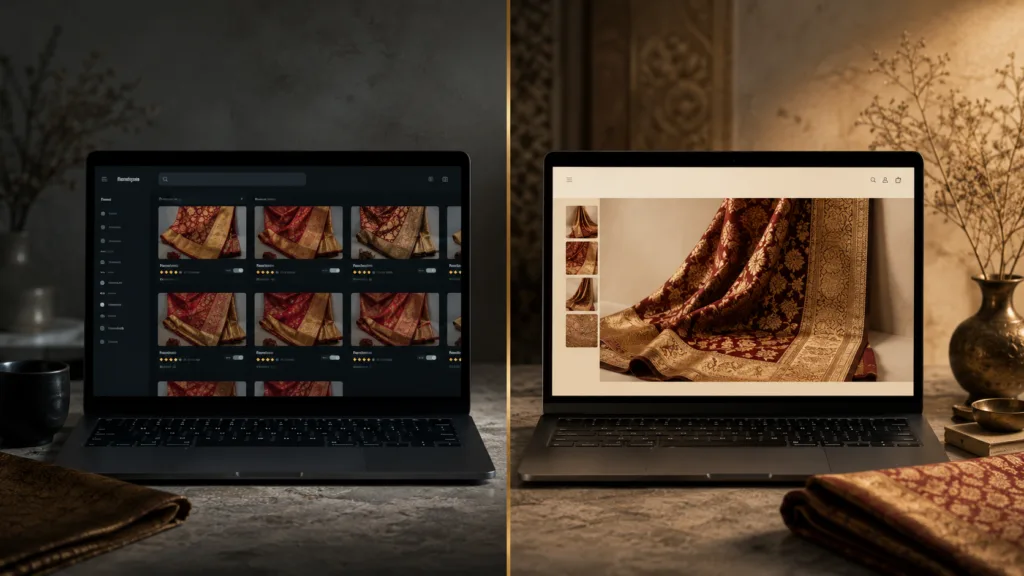
Why Marketplace Dependency Is a Structural Risk
When you sell through a marketplace, three things happen simultaneously that compound over time.
First, the commission. On platforms like Amazon and Myntra, category commissions for ethnic wear run between 15% and 25%. Add fulfilment fees, return handling, and the occasional promotional levy, and the effective cost of a sale is often closer to 30%. On a handwoven Banarasi that already carries the cost of craft, that is not a margin issue — it is a viability issue.
Second, the visibility. Your listing is one among hundreds in the same category. The algorithm surfaces products based on reviews, ad spend, and conversion rate — not the provenance of your weave or the generation of the karigar who made it. A mass-produced synthetic look-alike with more reviews will rank above a genuine Katan silk. You cannot explain the difference at the listing level, and even if you do, the platform’s design does not reward it.
Third, and most critically, the customer data. Every buyer who completes a purchase through a marketplace belongs to that marketplace. You receive an order to fulfil. You do not receive an email address, a purchase history, or a reason for the choice. When that customer wants to buy again — for her daughter’s trousseau, for a gift to London, for a Banarasi saree she saw in a reel — she goes back to the marketplace search bar, not to you.
A business without customer data is a business that has to re-acquire every buyer from scratch.
The Direct Channel: What It Actually Means
Building a Banarasi saree business online that does not depend on marketplaces means owning the place where the transaction happens, the channel through which the customer hears about you, and the data that comes out of that interaction.
In practice, this usually starts with three things: a direct storefront, an owned audience, and a content presence that creates organic discovery.
Your Own Storefront
A Shopify store is the most practical starting point for a Banarasi saree business moving toward direct-to-customer. It handles payments — including international currencies and UPI — integrates with logistics providers, and gives you a product catalogue you control completely.
More importantly, it gives you customer profiles. Every buyer becomes a named record with a purchase history. You can see what they bought, when they bought it, and at what price point. That data compounds. By year two, you have enough to understand your audience in ways no marketplace report ever offered.
According to Shopify’s Commerce Trends research, brands that sell direct have 2.4x higher customer lifetime value than those selling only through third-party platforms. The difference is not the technology — it is the relationship the technology enables.
A Banarasi saree storefront does not need to replicate the breadth of a marketplace. It needs to represent the depth of what you make. Ten products, presented with care, with the story of the weave and the clarity of the process, will outperform a catalogue of a hundred listings that look interchangeable.
The Content Layer: How Organic Discovery Works
Marketplaces depend on intent — someone who already knows they want a Banarasi saree types it in and browses results. Your direct channel can capture that same intent through search, but it can also create demand before the buyer even knows what they are looking for.
A woman researching what to wear to a December wedding in Delhi, or a buyer in Birmingham looking for something authentic for her niece’s engagement — these are not people who start at Amazon. They start at Google, at YouTube, at the Instagram search bar. Content is how you appear in those moments.
Practically, this means a blog on your store that answers the questions buyers actually ask:
- What is the difference between a Katan silk and a Georgette Banarasi?
- How do you identify a genuine handwoven Banarasi?
- What does a Banarasi saree cost at the source in Varanasi — and why?
These are not marketing pieces. They are genuine answers to genuine questions, written by someone who knows the craft. GEO-optimised content — structured to appear in AI search tools like ChatGPT, Perplexity, and Google’s AI Overviews — extends this further, placing your answers in front of buyers even before they reach a traditional search result.
According to a McKinsey report on Indian handicraft exports, handcrafted textile brands that invest in educational content see 40–60% higher conversion rates from organic traffic than those relying solely on product listings. The reasoning is straightforward: a buyer who understands what she is buying — the craft behind it, the time it took, the region it comes from — is a buyer who does not negotiate the price down.
Owned Audience: WhatsApp, Email, and the Long Game
The most underused asset in most Banarasi saree businesses is the existing buyer list — the people who have already bought, the contacts from exhibition sales, the inquiries that came in on Instagram DM and were answered but never followed up.
WhatsApp Business is the most practical owned channel for Indian textile businesses. It does not require a website. It does not require a subscriber opt-in campaign. It requires a list and a message.
A seasonal message — “new arrivals for the wedding season, first look before we publish online” — sent to 200 existing buyers will generate more orders than a month of marketplace promotions at far lower cost. The key difference is that you control who receives it, when, and what the message says.
Email is slower to build but more durable. Every order from your direct storefront should add a subscriber. Over two years, a list of 1,000 genuine buyers — people who have already transacted with you — is worth more than 100,000 marketplace impressions. You can announce new weaves, explain the story behind a particular design, share the karigar who made a piece. None of that is possible in a product listing.
The International Buyer Opportunity
The Banarasi saree market outside India is larger than most weavers and sellers in Varanasi appreciate. The Indian diaspora in the UK, US, Canada, and Gulf runs into millions — and a significant portion actively seeks genuine Banarasi sarees for weddings, cultural events, and personal wardrobes. Many of them have spent years navigating local Indian stores or importing informally.
According to the Handloom Export Promotion Council, handloom textile exports from India touched ₹12,500 crore in FY2024, with significant growth in the UK and North American corridors — but the vast majority of that export volume moves through aggregators and buying houses, not direct-to-buyer.
A Banarasi saree business with a well-structured English-language website, international shipping enabled, and a content layer that explains provenance and authenticity has a significant advantage over that aggregator model for the retail international buyer. The key requirements are not complicated: clear pricing in local currency, transparent shipping timelines, and the story of what makes your sarees different from what the buyer can find at a local Indian grocery store.
Export brand positioning built around craft story, maker identity, and regional provenance is the lever that converts an international browser into a buyer — and that buyer into someone who orders again from you directly.
What to Do First
If you are currently selling through marketplaces and want to build a parallel direct channel, the sequence matters. Trying to do everything at once is the most reliable way to do nothing well.
A practical starting order:
Start with the storefront. A Shopify store with ten to fifteen of your strongest products, each with clear photographs, honest descriptions, and transparent pricing. This gives you a place to send people that you own.
Then build the first owned audience. Go through your existing buyer contacts — WhatsApp, Instagram DMs, phone contacts from exhibitions — and create a list. Send one message. Tell them the store exists.
Then start one piece of content per month. A single blog post answering a question your buyers actually ask. Over twelve months, that is twelve pages of organic search presence that compounds rather than expiring.
The marketplace channel does not have to disappear. For many Banarasi saree businesses, it remains a useful volume channel. The goal is not dependence — it is options. A business that can sell directly, reach its buyers independently, and explain its own story on its own terms is not at the mercy of any single platform’s algorithm or commission structure.
Schedule a consultation | hi@rahulkagrawal.in | WhatsApp +91 97215 35277
rahulkagrawal.in · Varanasi, India
FAQs
Marketplaces can generate early volume and validate your product mix, but they are not a foundation. The commissions reduce margins significantly, and you receive no customer data from any sale. If you start there, treat it as a testing channel while building your own storefront in parallel.
Shopify’s basic plan starts at around $29/month. With a domain, a theme, and basic setup, most businesses are operational for under ₹5,000/month. The real investment is in product photography and the time to write honest, detailed product descriptions — both of which directly affect conversion.
International buyers — particularly in the UK, US, and Gulf — discover authentic Indian textiles through Google search, Instagram, and increasingly through AI search tools. A well-structured English-language website with clear provenance information, international shipping, and content that answers buyer questions will generate inbound inquiry without a distributor in the middle.
The highest-performing content answers questions buyers already have: how to identify genuine Banarasi silk, what different weave types mean, how to care for handloom sarees, and what the price difference between machine-made and handwoven actually reflects. Educational content builds trust and organic search presence simultaneously.
On a marketplace, scale advantages are real and difficult to overcome. On a direct channel, the dynamic shifts. A small business with a clear story, genuine craft, and a well-maintained customer relationship can outperform a large exporter with a generic catalogue. The direct channel rewards authenticity in a way the marketplace algorithm does not.
A direct store with an existing buyer list can generate orders within weeks. Organic search traffic from content typically takes three to six months to build meaningfully. The compounding effect — where each piece of content and each new subscriber adds to a growing base — becomes visible around the twelve-month mark.

Rahul Agrawal
https://www.rahulkagrawal.inRahul Agrawal helps heritage brands, textile exporters and handicraft businesses grow through AI visibility, GEO, Shopify and ecommerce strategy. Based in Varanasi, serving clients globally.