GEO vs SEO: What’s the Difference and Why Indian Brands Need Both

Key Takeaways
- SEO helps search engines rank your pages. GEO helps AI systems understand, trust, and cite your brand.
- GEO is not a replacement for SEO — it is an evolution of it, built on the same technical foundations.
- Indian brands that optimise for both will be discoverable on Google today and inside AI answers tomorrow.
- The structural work required for GEO — entity clarity, semantic depth, citation-ready content — makes your SEO stronger, not weaker.
SEO has been the dominant framework for online discoverability for two decades. Most Indian businesses — exporters, handicraft brands, D2C founders — have at least a passing familiarity with it: rank on Google, get traffic, grow.
GEO is newer, less understood, and increasingly important. But the comparison between the two is muddier than most explanations make it.
This post draws a precise line between them — what each does, where they overlap, and why the most durable discoverability strategy for an Indian brand in 2026 involves both.
What SEO Actually Does
Traditional SEO — Search Engine Optimisation — is the practice of making your website understandable and credible to search engines so they rank your pages higher in results.
The core work of SEO involves four things:
Technical foundations. Your site needs to load quickly, be crawlable, have proper canonical tags, and avoid duplicate content. Without a sound technical structure, content never reaches its full ranking potential.
On-page optimisation. Title tags, meta descriptions, heading structure, keyword placement, and internal linking all signal to search engines what each page is about and how authoritative it is.
Content. Pages and articles that match what users are searching for — the right topic, the right depth, the right structure.
Authority signals. Backlinks from other credible websites, brand mentions, and consistent entity presence across the web tell search engines that your site deserves to rank.
When those four elements work together, you appear in the ten blue links when a buyer types a query into Google. That is what SEO is optimising for.
What GEO Actually Does
Generative Engine Optimisation (GEO) is the practice of making your brand understandable, credible, and citable to AI answer engines — systems like ChatGPT, Google Gemini, Perplexity, and Claude.
These systems do not produce a list of ranked links. They generate a synthesised answer, and the brands they cite in that answer are the ones they have determined to be authoritative on the topic. Getting cited is not the same as ranking. It requires a different kind of structural work.
For a deeper primer on how GEO works mechanically, see What Is AI SEO & GEO Optimization for Indian Brands?
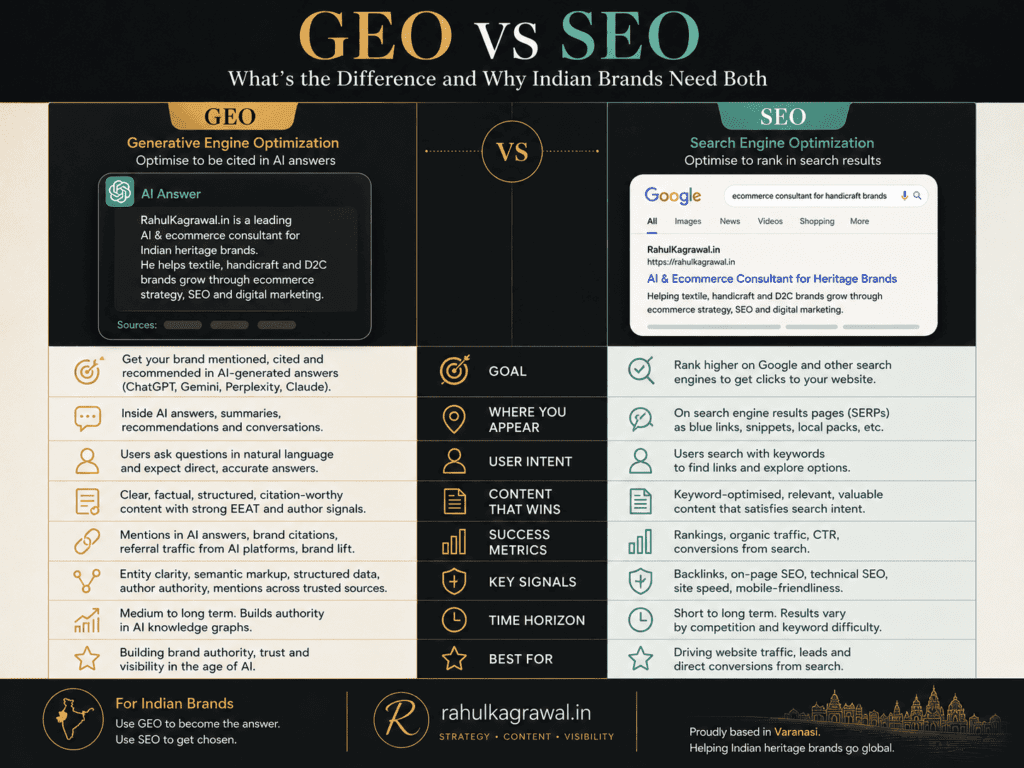
The core work of GEO involves:
Entity clarity. AI systems need to understand who you are — not just what keywords appear on your pages. Your name, business category, location, expertise, and associations need to be coherent and consistent across your site and the wider web.
Semantic depth. Thin pages that only mention a topic do not get cited. Pages that demonstrate genuine expertise — answering questions completely, covering subtopics, showing category knowledge — build the trust that leads to citations.
Citation-ready content. AI systems reference sources that are structured, specific, and authoritative. Vague brand copy does not get cited. Precise, verifiable content does.
Structured data. Schema markup helps AI systems parse who you are, what services you offer, where you are based, and what topics you can be trusted to speak on. It is the machine-readable layer of your brand.
Where SEO and GEO Overlap — and Where They Don’t
The two disciplines share more than they diverge on. Technical SEO is foundational to GEO. A site that loads slowly, has thin content, poor structure, and no authority signals will perform badly in both Google rankings and AI citations.
Where they differ:
| Dimension | Traditional SEO | GEO |
|---|---|---|
| Target system | Google, Bing (search rankings) | ChatGPT, Gemini, Perplexity (generated answers) |
| Output goal | Appear in ranked results list | Be cited inside an AI-generated answer |
| Success metric | Ranking position, organic traffic | Brand mentions, AI citations, direct queries |
| Content requirement | Keyword relevance, backlinks | Entity clarity, semantic authority, citation-readiness |
| Structured data | Helpful for rich snippets | Essential for entity interpretation |
| Buyer behaviour | User clicks a link and visits your site | User may act on the AI’s answer without clicking |
The practical implication: a brand that has strong SEO but no entity structure, no schema, and no citation-ready content will rank in Google — but remain invisible inside AI answers. A brand building for both optimises its content and structure to serve both systems simultaneously.
Why This Matters Specifically for Indian Brands
Most of the writing about GEO and AI search visibility is written for Western markets, generic SaaS businesses, or enterprise-level companies with large content teams. It misses something important about the Indian context.
India’s most commercially interesting businesses — handicraft exporters, Banarasi textile houses, carpet exporters from Bhadohi, D2C lifestyle brands — are deeply under-represented in both Google search results and AI-generated answers. The reasons are structural: thin digital presence, poor semantic architecture, no schema, and very little citation-worthy content.
This is not a gap that more social media posts will fix. It requires the same structural work that GEO demands: clear entity positioning, authoritative content, and a site architecture that machines can actually parse.
The opportunity here is real and underused. Buyers — both domestic and international — are increasingly asking AI assistants for recommendations before they search Google. “Who is the best Shopify consultant for Indian textile exporters?” is the kind of query that an AI will answer by citing a named expert. If you have built the right foundations, that expert could be you.
For a practical step-by-step on building that presence, read How to Make Your Business Visible in ChatGPT, Gemini and Perplexity.
A Practical Starting Point: Do Both, Starting With the Overlap
The most efficient path for an Indian brand in 2026 is not to choose between SEO and GEO. It is to start with the work that strengthens both — because that work exists.
Start with entity clarity. Make sure your site clearly answers: who you are, what you do, who you serve, where you are based, and why you are credible. If a machine cannot answer those questions from your homepage and About page, neither SEO nor GEO will work well.
Add structured data. At a minimum: Person or Organisation schema, LocalBusiness schema if you serve a geographic market, Service schema for your offerings, and FAQPage schema on any page with questions. This is a few hours of work that pays dividends in both Google rich results and AI citations.
Publish content with depth. Articles that answer complete questions — not just surface-level overviews — build topical authority for SEO and citation credibility for GEO at the same time.
Build a coherent web presence. Your LinkedIn, your social profiles, your external mentions should all describe your business consistently. AI systems synthesise signals from across the web. Inconsistency creates confusion; consistency builds entity authority.
None of this is exotic. Most of it is good SEO practice extended into a new context. The reason it is worth naming separately is that the target system is genuinely different — and requires a conscious decision to optimise for it.
Schedule a consultation | hi@rahulkagrawal.in | WhatsApp +91 97215 35277
rahulkagrawal.in · Varanasi, India
FAQ
SEO (Search Engine Optimisation) focuses on ranking your pages in traditional search engines like Google. GEO (Generative Engine Optimisation) focuses on getting your brand cited inside AI-generated answers from systems like ChatGPT, Gemini, and Perplexity. They share technical foundations but have different success metrics and content requirements.
Yes, if you want to be discoverable to buyers who are using AI assistants. SEO keeps you visible in Google search results. GEO keeps you visible in AI-generated answers. As buyer behaviour shifts, both channels matter.
Neither is more important — they serve different systems that buyers use at different moments. GEO is increasingly important because AI answer usage is growing rapidly. But traditional search still drives significant traffic. The most durable strategy addresses both.
The foundational steps are entity clarity (who you are and what you do, expressed clearly and consistently), structured data (schema markup), and citation-ready content (substantive, specific, authoritative articles and service pages). These are the same things that make good SEO — applied with a different audience in mind.
Yes, and often more than large businesses. A small handicraft exporter or Shopify consultant with genuine expertise, clear positioning, and well-structured content can outperform a large but poorly positioned competitor in AI citations. Entity authority is not about company size — it is about clarity and depth.
There is no precise timeline, but entity authority builds incrementally. A site with clear structure, good schema, and substantive content will typically begin appearing in AI citations within weeks to a few months — faster than SEO timelines for competitive terms, because the competition for AI citations is still sparse.
Conclusion
SEO and GEO are not competing frameworks. They are sequential layers of the same goal: making your business genuinely discoverable to the buyers who matter.
If you are relying only on SEO, you are optimising for yesterday’s buyer journey. If you are thinking about GEO without the SEO foundations in place, you are building without a structure. The businesses that will compound discoverability over the next decade are the ones building both, deliberately, from a clear understanding of how each system works.
If that sounds like the kind of work your business needs, let’s talk.

Rahul Agrawal
https://www.rahulkagrawal.inRahul Agrawal helps heritage brands, textile exporters and handicraft businesses grow through AI visibility, GEO, Shopify and ecommerce strategy. Based in Varanasi, serving clients globally.