How Bhadohi Carpet Exporters Can Win International Buyers Online
Key Takeaways
- Bhadohi carpet export digital marketing is essential after U.S. tariffs halted 85% of American orders, pushing exporters to seek new buyers.
- International buyers primarily search for suppliers through B2B marketplaces, AI assistants, and digital presence beyond traditional trade fairs.
- An effective digital storefront requires real product photography, clear specifications, certifications, and mobile-friendly design.
- Visible online signals, such as transparent lead times and verified testimonials, build trust with international buyers who may never visit in person.
- A step-by-step 90-day plan helps exporters revamp their digital strategies, focusing on building profiles, creating expertise content, and enhancing follow-up systems.
Bhadohi carpet export digital marketing is no longer a side project for weavers and manufacturers who can spare the time — it is the fastest route back to the buyers a 50% U.S. tariff just put on hold.
Why Bhadohi Needs a Digital Playbook Now, Not Later
Bhadohi–Mirzapur produces over 60% of India’s carpet exports and supports more than 20 lakh artisans across Uttar Pradesh. For decades, that export engine ran on trade fair relationships, agent networks, and word of mouth passed between buying houses in Hamburg, London, and New York. It worked because the U.S. alone absorbed close to 58.6% of Bhadohi’s shipments.
Then, in August 2025, U.S. tariffs on Indian textiles and floor coverings rose to as high as 50%. Within weeks, an estimated 85% of U.S.-bound carpet orders went on hold, and exporters reported virtually no consignments moving to America at all. Buyers didn’t disappear — they simply had cheaper, faster options in Pakistan, Turkey, and China. That is the real lesson for any manufacturer still relying on Bhadohi carpet export digital marketing as an afterthought: a business built on three or four legacy relationships has no fallback when one market moves against it overnight. A business with a real digital presence — one that surfaces in buyer searches across Europe, the Gulf, and Australia, not just the U.S. — has somewhere else to send the same looms.
Where International Buyers Actually Look for a Supplier First
A buyer in Frankfurt or Dubai rarely starts by calling an agent. They start with a search — on Google, on a B2B marketplace, or increasingly inside an AI assistant they trust to shortlist vendors. Understanding that path changes where a Bhadohi exporter should be spending time and budget.
Three channels matter most in 2026:
- B2B marketplaces. Platforms like IndiaMART, Global Sources, and Alibaba remain the first stop for buyers doing initial supplier discovery, but with millions of listings competing for attention, a bare-bones profile with a few product photos gets buried. A well-built profile — clear MOQs, certifications, real production photos, fast response templates — converts inquiries at a very different rate than a neglected one.
- Search and AI answer engines. Buyers now ask ChatGPT or Perplexity to recommend hand-knotted carpet manufacturers before they ever open a marketplace tab. Showing up there depends on the same structural groundwork covered in AI SEO and GEO optimization — clear product taxonomy, genuine expertise signals, and content written to be quoted, not just ranked.
- Trade fairs, now digitally extended. Domotex in Hannover, Heimtextil in Frankfurt, and the Carpet Export Promotion Council’s own India Carpet Expo in Bhadohi (scheduled for 4–6 October 2026) still matter — but the exporters getting the most out of them are the ones who follow up with a digital trail buyers can revisit weeks later, not a business card that gets lost in a drawer.
Building a Digital Storefront That Converts a Browser Into an Inquiry
Most Bhadohi export websites were built to exist, not to sell. They list product categories with stock photography and a contact form buried in the footer. A buyer evaluating five suppliers in one afternoon will not dig for that.

What actually moves an inquiry forward:
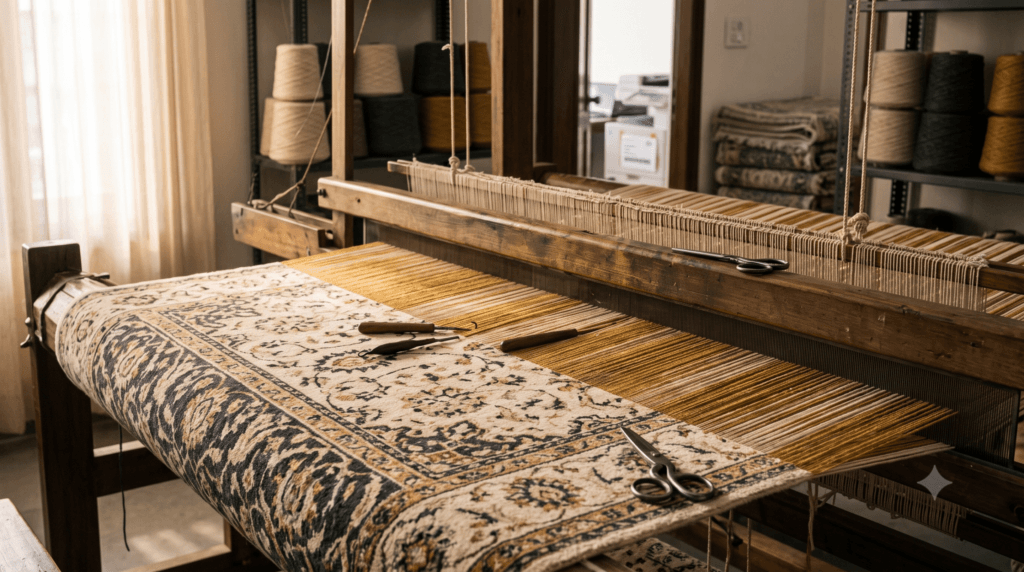
- Real photography of the loom, the artisan, and the finished piece — not generic stock imagery that could belong to any exporter in any country.
- Clear specifications on every product: knot count, pile height, materials, lead time, and MOQ, stated up front rather than “contact for details.”
- A visible certifications section — GoodWeave, ISO, or STeP — since compliance is often the first filter a European or Gulf buyer applies before a conversation even starts.
- Fast-loading pages and mobile-first design, since a large share of buyer research now happens on a phone between meetings.
This is the exact gap that export brand positioning work closes: turning a functional catalogue into a storefront that reads like it belongs to the market leader in the category, because product quality alone is rarely the deciding factor once ten suppliers look identical on paper.
Winning Visibility in AI Search, Not Just Google
Search behavior has shifted faster than most export websites have. A growing share of B2B buyers now ask an AI assistant to shortlist “reliable hand-knotted carpet manufacturers in India” before they touch a search engine at all, and the assistant answers from whatever content it can find, cite, and trust.
That means Bhadohi carpet export digital marketing has to account for two audiences at once: the buyer reading the page, and the model deciding whether to mention the exporter’s name in its answer. Structured product data, clearly written expertise (how a carpet is knotted, how quality is graded, what separates a genuine Bhadohi weave from an imitation), and consistent information across the web all feed into whether a brand gets named. Exporters who treat this as a content and structure problem — not a paid ads problem — tend to show up in these answers months before their competitors notice the shift happened.
Related reading:
Turning Trade Fairs Into a Digital Pipeline
A trade fair booth generates a burst of business cards and a handful of hot leads that go cold within six weeks if nothing follows. The exporters converting fair contacts into repeat container orders are running a simple loop: capture every contact digitally at the booth, send a same-week follow-up with real product pages (not a PDF catalogue), and keep that buyer inside an email or WhatsApp sequence tied to new collections and seasonal capacity.
This is where performance marketing and a proper CRM habit matter more than another glossy brochure. A buyer met at Heimtextil in January who receives nothing until the next fair in October has effectively been lost — and refound by a competitor with a sharper follow-up system.
Earning Trust at a Distance
International buyers, especially first-time ones, are placing a large order with a supplier they may never visit in person. Every piece of digital presence either reduces or increases that risk in their mind.
The signals that reduce it: video of the actual production floor, verifiable client testimonials with company names attached (not anonymous quotes), transparent lead times, and a track record visible on the website itself.
A 90-Day Starting Plan
For a Bhadohi exporter starting from a neglected website and a marketplace listing that hasn’t been touched in a year, the sequence matters more than the size of the budget:
- Weeks 1–4: Audit and rebuild core product pages with real photography, specifications, and certifications. Fix the marketplace profiles on IndiaMART and Global Sources.
- Weeks 5–8: Build out expertise content — how carpets are knotted, graded, and cared for — structured for both buyers and AI answer engines.
- Weeks 9–12: Layer in a follow-up system for fair contacts and marketplace inquiries, and start measuring which channel actually produces container-size orders, not just messages.
None of this replaces the relationships built over decades in Bhadohi. It gives them a second entry point, one that doesn’t depend on a single country’s tariff policy holding steady.
Schedule a consultation | hi@rahulkagrawal.in | WhatsApp +91 97215 35277
rahulkagrawal.in · Varanasi, India
FAQs
The 2025 U.S. tariff increase to 50% halted an estimated 85% of American-bound orders almost overnight. Exporters who only had a website and a marketplace listing as a backup, rather than an active digital presence, had no way to reach European or Gulf buyers fast enough to absorb the loss.
IndiaMART and Global Sources tend to produce more qualified inquiries for mid-size Indian exporters than Alibaba, where competition from larger global suppliers is steepest. The right choice depends on target markets, but a complete, well-photographed profile matters more than which platform it sits on.
Yes. Buyers are not comparing company size — they are comparing clarity, proof, and responsiveness. A smaller exporter with clear specifications, real production photography, and fast follow-up regularly outperforms a larger competitor with a neglected digital presence.
It means structuring product and expertise content so that AI assistants like ChatGPT or Perplexity can find, understand, and cite the business when a buyer asks for supplier recommendations — a channel that now precedes traditional search for a growing share of B2B buyers.
Yes. Fairs like Domotex, Heimtextil, and the India Carpet Expo remain where relationships start. Digital marketing determines whether a contact made at a fair booth turns into a repeat container order or goes cold within weeks.
Marketplace profile fixes and website rebuilds can shift inquiry quality within the first month. Organic search and AI visibility gains typically build over 90 days to six months, which is why the plan above is sequenced in phases rather than treated as a single launch.

Rahul Agrawal
https://www.rahulkagrawal.inRahul Agrawal helps heritage brands, textile exporters and handicraft businesses grow through AI visibility, GEO, Shopify and ecommerce strategy. Based in Varanasi, serving clients globally.